
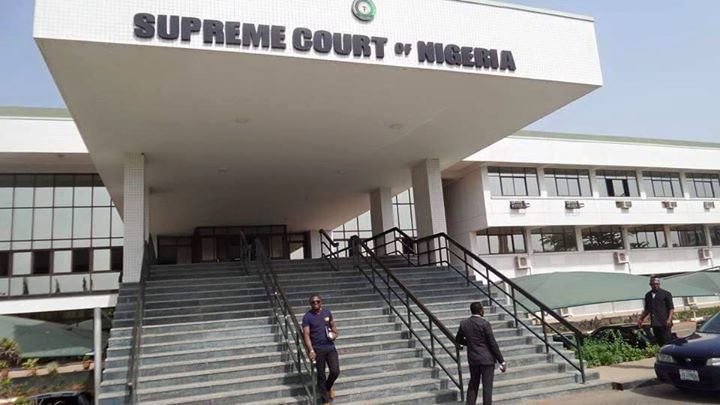
Supreme court rule president can suspend governors during state of emergency


Nigeria’s Supreme Court has ruled that the President has the constitutional power to declare a state of emergency in any state to prevent a breakdown of law and order or a slide into chaos, including the authority to suspend elected officials for a limited period.
In a sharply divided six-to-one judgment, the apex court held that while such suspensions are permissible under emergency rule, they must be time-bound and exercised strictly within constitutional limits.
Delivering the lead judgment, Justice Mohammed Idris said Section 305 of the Constitution empowers the President to take “extraordinary measures” once a state of emergency has been proclaimed. He noted that the provision does not spell out what those measures should be, thereby granting the President wide discretion in restoring normalcy.
The ruling arose from a suit filed by Adamawa State and 10 other states governed by the Peoples Democratic Party, which challenged the legality of the state of emergency declared by President Bola Tinubu in Rivers State. During the emergency, elected officials — including Governor Siminalayi Fubara — were suspended for six months.
Justice Idris first upheld preliminary objections raised by the Attorney General of the Federation and the National Assembly, ruling that the plaintiffs had failed to establish a cause of action capable of invoking the original jurisdiction of the Supreme Court of Nigeria.
He consequently struck out the suit for want of jurisdiction but went further to consider its merits, ultimately dismissing it in its entirety.
However, the decision was not unanimous. Justice Obande Ogbuinya dissented, holding that while the President has the power to declare a state of emergency, that authority does not extend to suspending elected state officials such as governors, deputy governors and members of state assemblies.
Justice Ogbuinya ruled that the case succeeded in part, arguing that the suspension of elected officials amounted to an unconstitutional overreach of executive power.