

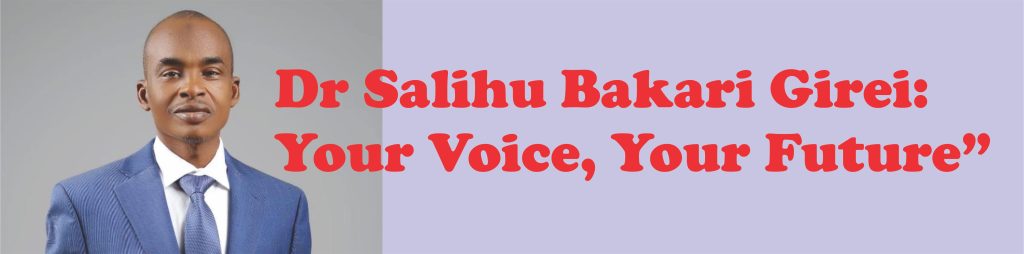
Dr Salihu Bakari Girei unveils peoplefirst vision for Adamawa


Every election cycle in Adamawa produces a document of this kind: ambitious, wide-ranging and steeped in the language of transformation. What sets Dr Salihu Bakari Girei’s covenant document apart is not its scale, but its structure an effort to move beyond rhetoric towards something more deliberate: a governance blueprint anchored in systems rather than slogans.
Its diagnosis is hardly new. Adamawa’s challenge is not scarcity, but coordination. A state rich in agricultural potential still grapples with food insecurity. Its youthful population remains underemployed. Schools exist, yet learning outcomes are weak; hospitals stand, but healthcare delivery falters. In this respect, the document is right to frame the problem as one of governance, not destiny.
Where the proposal gains traction is in its focus on foundations. Education, primary healthcare, rural infrastructure and civil service efficiency are treated not as campaign ornaments, but as the bedrock on which broader development must rest. It is a subtle but significant shift. Too often, political programmes in Nigeria prioritise visible projects over the quieter work of building functional systems.
There is, however, a familiar risk: overreach. The 10-point agenda is expansive — spanning mineral value chains, the digital economy, youth financing and traditional institutions. Each element is sensible in isolation, but together they raise questions of focus. Governments rarely fail for lack of ideas; they falter when ambition outpaces sequencing.
The document’s emphasis on human capital is another strength. Its repeated focus on teachers, healthcare workers and youth empowerment reflects an understanding that development is, ultimately, about people rather than infrastructure. Yet intent alone is not enough. Delivery will require fiscal discipline, institutional autonomy and the political will to confront entrenched interests.
Girei’s reliance on his record in public service lends the document credibility, but also invites scrutiny. If these systemic shortcomings have long been understood from within, voters may reasonably ask why they have persisted — and whether experience alone is sufficient to disrupt them.
Perhaps the most striking feature is the framing of the programme as a “covenant” — an appeal to leadership as obligation rather than entitlement. In a political culture often shaped by patronage and short-term calculation, such language seeks to raise expectations. But a covenant, by definition, demands accountability. Promises of inclusion, transparency and efficiency must be measurable, not merely aspirational.
What emerges is a reflection of a broader shift in Nigerian subnational politics: a gradual move from personality-driven campaigns towards policy-led narratives. Whether that shift produces meaningful change remains uncertain.
Adamawa does not lack plans. It lacks execution.
If this covenant is to stand apart, it will be judged not by the breadth of its vision, but by the discipline of its delivery — the ability to set priorities, build institutions and sustain reform beyond the electoral cycle. Without that, it risks becoming yet another well-crafted promise overtaken by familiar realities.