
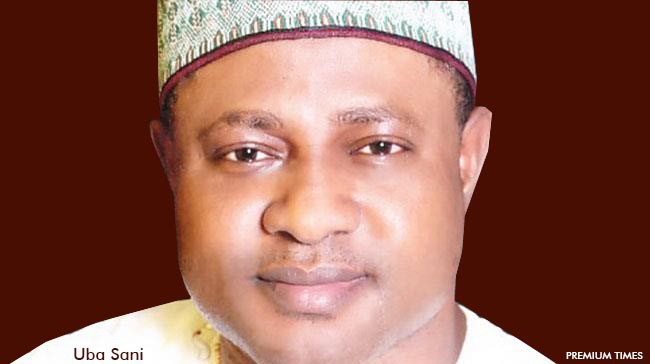
Nigeria’s revenue rises sharply under Tinubu tax reforms – Uba Sani


Kaduna State governor, Uba Sani, says Nigeria’s tax revenue rose to about ₦21.6tn in the first half of 2026, following reforms introduced by President Bola Tinubu’s administration.
Sani made the disclosure on Wednesday at the 160th meeting of the Joint Revenue Board in Kaduna, held under the theme: “One Year of Tax Reform: Assessing Progress and Addressing Challenges”.


He said national revenue had risen from about ₦10.1tn in 2023 to ₦21.6tn in 2024 and approximately ₦36.8tn in 2025.
“In the first half of 2026 alone, revenue reached approximately ₦21.6tn, representing a 49% increase over the corresponding period of the previous year,” he said.
The governor commended Tinubu for what he described as a bold and politically demanding decision to overhaul Nigeria’s tax system through landmark legislation, including the law that transformed the former Joint Tax Board into the Joint Revenue Board.
HAPPY BIRTHDAY, SIR


HIS EXCELLENCY, RT. HON. AHMADU UMARU FINTIRI
HAPPY 59TH BIRTHDAY, YOUR EXCELLENCY! The Governing Council, Management, Staff and entire University Community of Adamawa State University, Mubi, heartily felicitate with Your Excellency on the joyous occasion of your 59th birthday. We celebrate your commitment to educational advancement and the development of Adamawa State. May Almighty God grant you sound health, divine wisdom, long life and greater accomplishments. Happy 59th Birthday, Your Excellency!
Professor Clement Augustine, Vice Chancellor, ADSU, Mubi
Sani said the reforms recognised that a modern economy could not be sustained by an outdated, fragmented and overly complex revenue system.
“Nigeria requires a tax architecture that is coherent, predictable, efficient and capable of supporting national development without unnecessarily constraining enterprise and investment,” he said.
He also praised the chairman of the Nigeria Revenue Service, Zach Adedeji, for his leadership in advancing the tax reform programme.
Sani said Adedeji’s contribution went beyond technical competence, describing his approach as focused on increasing revenue mobilisation while making the tax system simpler, fairer and more predictable for taxpayers.
He also commended the immediate past executive chairman of the Kaduna State Internal Revenue Service, Jerry Adams, and his team for increasing the state’s internally generated revenue from about ₦4bn to ₦10bn monthly.
The governor said the revenue figures represented more than fiscal statistics, arguing that they demonstrated Nigeria’s growing capacity to finance development from domestic resources.
According to him, the reforms are intended to simplify the tax environment, reduce multiple and overlapping taxation, deploy technology and e-invoicing to curb leakages, consolidate revenue administration and rebuild trust between government and taxpayers.
Sani said sustainable taxation could not be based on coercion alone but required fairness, transparency, predictability and trust.
“Citizens and businesses are more likely to comply when they understand their obligations, encounter a system that is straightforward to navigate, and have confidence that the resources they contribute are being responsibly applied to the public good,” he said.
He added that the goal should not simply be to collect more revenue but to create a tax system in which compliance was easier, enforcement more intelligent and voluntary participation the norm.
Sani said Kaduna had embraced the approach through investments in technology-driven revenue collection, professionalisation of its revenue workforce and stronger taxpayer education and engagement.
“Our objective is not simply to increase collections, but to build a revenue system that is broader, fairer, more efficient and more sustainable,” he said.
“We seek to expand the tax base rather than continually place a heavier burden on the same compliant taxpayers. We seek to make compliance easier and enforcement more intelligent, targeted and transparent.”
He said the state also sought to build a relationship with taxpayers based on clarity, fairness and mutual responsibility rather than fear.