
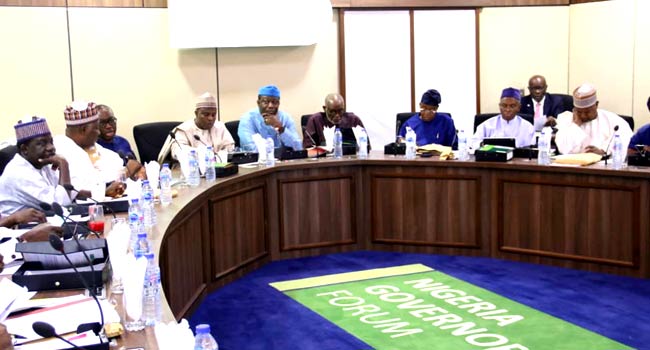
Nigerian governors weigh ₦100,000 minimum wage as living costs soar


Nigeria governors consider ₦100,000 minimum wage amid cost of living crisis
State leaders say talks with federal government and labour unions aim to balance workers’ welfare with fiscal realities
State governors across Nigeria are considering a proposal to raise the national minimum wage to ₦100,000 a month, as mounting inflation and a worsening cost of living crisis place increasing pressure on households.
The chairman of the Nigeria Governors’ Forum (NGF) and governor of Kwara state, AbdulRahman AbdulRazaq, said discussions were under way between state governments, the federal government and organised labour to agree a wage structure that would improve workers’ welfare without jeopardising public finances.
In a statement posted on Facebook on Saturday, AbdulRazaq said governors recognised the growing hardship faced by millions of Nigerians and the need for a response that reflected current economic realities.
“State governments recognise the urgent need to improve workers’ welfare in response to the current economic realities facing Nigerians,” he said.
The proposal would raise the national minimum wage from the current ₦70,000 per month, representing an increase of nearly 43%. It comes as workers continue to struggle with soaring food prices, higher transport costs and rising living expenses following a series of economic reforms that have sharply increased household costs.
AbdulRazaq said consultations remained ongoing and stressed that any agreement must be financially sustainable for state governments, many of which face significant budgetary constraints despite increased federal allocations.

“We are actively engaging with the Federal Government and organised labour to arrive at a wage structure that is fair to workers and sustainable for government finances,” he said.
According to the NGF chairman, discussions are focused on striking a balance between improving workers’ purchasing power and ensuring that governments can continue to fund essential services, infrastructure projects and development programmes.
“The goal is to improve the living conditions of workers while ensuring that states can continue to meet their obligations and sustain development projects that directly impact citizens,” he added.
The proposal is expected to intensify debate over wages and economic policy in Africa’s most populous country, where inflation has eroded the value of incomes and savings in recent years.
Labour unions have repeatedly argued that existing wage levels no longer reflect the realities faced by workers. The Nigeria Labour Congress (NLC) has continued to press for a broader review of salaries, insisting that workers deserve wages that provide a reasonable standard of living rather than mere subsistence.
Several states, including Lagos, Rivers and Imo, are already reported to be paying salaries above the national minimum wage benchmark in an effort to cushion the impact of economic hardship on workers.
While the prospect of a ₦100,000 minimum wage is likely to be welcomed by many employees, economists and policymakers are expected to scrutinise the affordability of such an increase for state governments and its potential impact on inflation.
No formal agreement has yet been reached, but the proposal signals growing recognition among political leaders that the current wage framework may no longer be sufficient to meet the needs of Nigerian workers.