
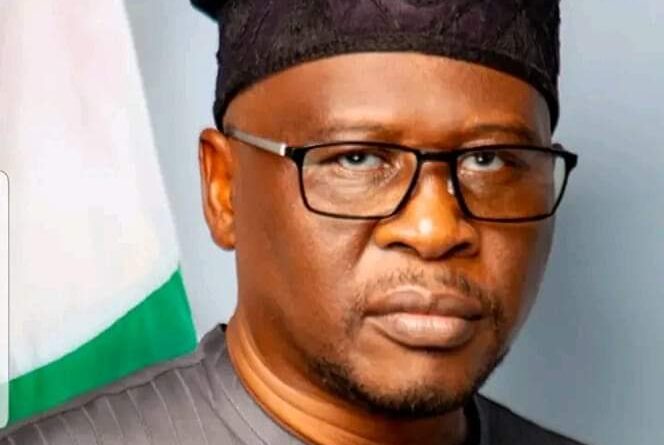
Adamawa Today: Beyond the Projects, Understanding the Fintiri Phenomenon


By Humwashi Wonosikou
Politics is often a theatre of appearances. What citizens see on podiums, campaign posters and television screens is usually only a fraction of the full picture. Leaders are defined publicly by titles, slogans, achievements and controversies, yet the true character of leadership is often shaped quietly by experience, struggle, discipline and personal conviction.
In Adamawa State today, Governor Ahmadu Umaru Fintiri represents one of those political figures whose public image tells only part of the story.
To many residents, Fintiri is first seen through the lens of performance. His political identity has largely been built around visible governance and infrastructural development. From roads and flyovers to schools, hospitals and rural development projects, the administration has consistently projected an image of a government focused on delivery.
But beyond the projects and political branding lies a deeper question: who exactly is the man behind the public image?
The answer may explain why Fintiri continues to dominate political conversations in Adamawa even beyond his current office.
Fintiri first gained major public attention during the political turbulence of 2014 when he briefly served as Acting Governor of Adamawa State. That period was marked by uncertainty and institutional instability. Yet within a short time, he earned public sympathy and admiration by addressing lingering salary arrears and restoring confidence within the civil service.
It was during that moment that many people began referring to him as “ATM,” not as mockery, but as recognition of his intervention in the lives of struggling workers and pensioners.
Years later, as a two term governor, his public reputation evolved into another political identity: “Mr. Project.”
Today, the physical evidence of governance is difficult to ignore. Flyovers now define parts of Jimeta’s urban landscape. Rural roads have expanded access to neglected communities. Public schools have received renewed investment. The state government’s support for free education and payment of examination fees has reduced financial burdens on thousands of families.
To supporters, these are not just projects. They are symbols of intentional leadership.
However, reducing Fintiri merely to infrastructure would be an incomplete reading of his political character.
Before becoming governor, he spent years navigating the complexities of legislative politics, eventually rising to become Speaker of the Adamawa State House of Assembly. That background appears to have shaped his approach to governance.
Unlike politicians who thrive on constant public drama, Fintiri often projects the image of a leader who prefers strategic calculation to unnecessary noise. Those within political circles frequently describe him as methodical, patient and deliberate in decision making.
Many of the projects celebrated today were reportedly preceded by long periods of negotiation, planning and administrative review. What the public eventually sees as completed infrastructure is often the final stage of months of political and bureaucratic coordination.
This style of leadership may not always attract dramatic headlines, but it reflects a certain administrative discipline that has become central to his political identity.
There is also the question of personal history.
Before Government House, there was Madagali, a region deeply affected by insurgency and displacement during some of the darkest periods in the North East. For many communities in that part of Adamawa, insecurity was not an abstract policy discussion. It was a painful lived experience.
That reality appears to have shaped Fintiri’s governance priorities, particularly in areas relating to security, reconstruction and resettlement.
Supporters often argue that his policies are not driven solely by politics, but also by memory and lived understanding. The investments in healthcare, education and community development are seen by many as responses to realities he personally witnessed long before assuming office.
Critics, of course, offer a different interpretation.
Some argue that beneath the calm public image is a strong political operator who understands power, controls political structures effectively and does not shy away from confrontation when necessary. Others believe his administration could communicate more openly with citizens on certain policy decisions and governance priorities.
Yet, even critics rarely deny his political effectiveness.
And perhaps that is what makes Fintiri politically significant in Adamawa today. He represents a combination that is often difficult to find in Nigerian politics: a politician who understands both governance and political survival.
Scripture reminds us in 1 Samuel 16:7 that “man looks at the outward appearance, but the Lord looks at the heart.”
The roads, bridges and schools are visible to everyone. The motivations, discipline and convictions behind them are less visible, but equally important.
As political discussions gradually shift toward the future, including possible national responsibilities after his governorship tenure, Adamawa people may eventually be forced to decide what matters more in leadership: noise or results, performance or propaganda, visibility or substance.
If the state ultimately chooses to send Ahmadu Umaru Fintiri to the Senate in the future, it would not merely be sending another politician to Abuja. It would be sending a leader shaped by legislative experience, political conflict, administrative discipline and the realities of a society that has endured both hardship and recovery.
Whether one agrees with his politics or not, one thing remains difficult to dispute: Fintiri’s leadership story is far more complex than the public mask alone reveals.